
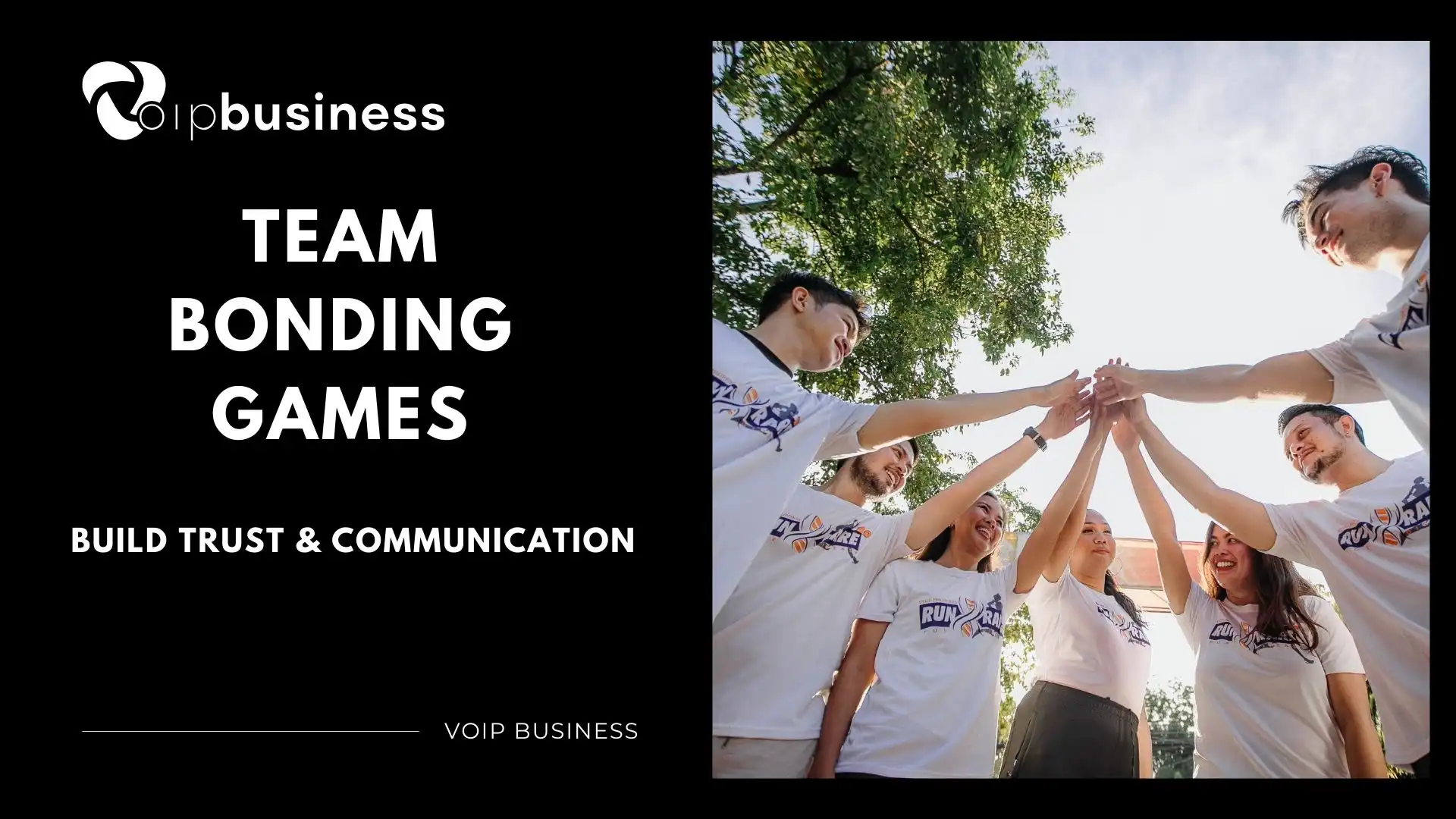
Every successful business has at its core a strong team. Creating a cohesive team requires focused attention, and this is one key element of a successful business that can be fostered through team bonding.
Business networking and relationship building are the essence of every organization. Having linked employees tend to get more productive and engaged and feel more gladness in their line of work.
This post will look closely at how cheap bonding games/workshop activities can positively change the dynamics of your organization and subsequently change the organizational climate.
What are Team Bonding Games?
Team bonding games are informal and structured games that encourage employees to relax and interact with one another. Team bonding games foster and help develop relationships, improve workplace morale, and build relationships through games.
It’s important to make a distinction between team bonding games and team building. Team building is targeted to help develop skills such as management or a specific focus on strategic planning, and this is done in a more formal approach.
Team bonding on the other hand, is done for the sole reason of social connection and to have fun. Skills that are learned through team bonding, such as communication, are a natural result of the interaction.
Benefits of Team Bonding Games
Scheduling some team bonding activities on a regular basis for your company can have a lot of benefits. For example:
i. Better Communication Skills
Several activities in games need team members to communicate and listen to one another to win. These games can help improve some of the workplace communication skills by shifting to a more open and free-form dialogue.
ii. More Trust
Active trust is one of the main aspects of strong cooperation. Gaining rapport, shared, positive, and even playful interactions can establish a sense of psychological safety in the workplace team.
iii. More Ability to Work Together
Often, team bonding activities bring to the table a prerequisite for a unified objective, which requires each and every one of the individuals to participate. This is beneficial for the spirit of For the Unity.
iv. Higher Work Satisfaction
Going on a game break and stepping away from work can shift the workplace to a more positive and happy atmosphere. Players in the game will energize the environment and assist in reducing stress.
v. Conflict Resolution
Low-stakes, game-based scenarios can be a safe space to practice navigating disagreements and finding common ground. These activities can highlight different communication styles and help team members learn how to resolve minor conflicts constructively.
5 Fun and Effective Team Bonding Games
Are you ready to begin? Look at these five well-known team bonding games that require minimal preparation and are very beneficial.
1. The Human Knot
This timeless activity highlights the importance of collaboration and communication in team settings while also serving as a fun mental exercise.
- How to play: Form a circle, standing shoulder to shoulder. Each player crosses their right hand to grab the hand of someone sitting opposite them. They then cross their left hand and grab the right hand of someone sitting opposite them. The goal of the activity is for the team to work together to form the shape of a circle without breaking the hand grips.
- Why this activity is effective: This task cannot be solved without communication. The team must work together to identify the best possible approaches and demonstrate patience while attempting to fully disengage from the knot.
2. Two Truths and a Lie
This is also another amazing way to ice-break in helping the team members to know each other on a different level is to play “Two Truths and a Lie”.
- How to play: Each player must come up with three “facts” about themselves – two that are true and one that is a lie. Then each player will take turns sharing their three statements. After this, the rest of the team will vote on each player’s lie that they think is the lie.
- Why it Works: This game sparks curiosity, encourages personal sharing, and often reveals surprising and fun facts about colleagues, building personal connections and trust.
3. Office Trivia
Here’s an idea to test team members’ knowledge with trivia games and office/team trivia questions. General knowledge trivia and some office trivia questions can also be used.
- How to Play: Split the participants into small groups. Formulate some trivia questions for the audience and host each team one team at a time. If the members of the team one at a time guess the answer, the team can win, and the team with the correct answer can gain a point.
- Why it Works: Trivia fosters collaboration. Also, it allows different members of the team to be recognized for certain knowledge.
4. Scavenger Hunt
Scavenger hunts are also a good type of teamwork-building activity. They allow people to work together while also staying active and getting fresh air.
- How to Play: You take an assortment of different lunchtime and office items, and create a list of haulable and non-haulable items for individuals or teams to take photos of. Split the people into teams, and the first one to complete the list wins.
- Why it Works: The task of competing to take the most items during the specified time encourages people to work together and collaborate in a strategic and time-based frame. This will also allow people to use skills outside of school and in an office setting.
5. Escape Room
Teaming the players up and putting them in a themed room for the activity where they will have to work together to solve a series of different puzzles in order to ‘escape’ from the room in a certain time frame.
- How to Play: Reserve a local escape room. It can be a small or large group with little to no prep work needed. The team will be ‘locked’ in a room and in order to escape, they will need to collaborate and work as a team to solve the room.
- Why It Works: In a comically themed, high-energy environment, escape rooms are the ultimate test of a team’s ability to communicate, problem solve, and keep their composure in an agile work setting.
Organizing Successful Team Bonding Events
Having a plan makes arranging your team bonding games a whole lot easier.
i. Set Clear Objectives
What are you trying to accomplish? Is it just for fun or is it for trying to engage in the collaboration of a specific team or improve the communication between certain departments?
ii. Pick Purposeful Games
Consider the team size, the games physical requirements, and the psychographics of the team. Make sure to pick games that are inclusive, or that everyone on the team will be able to participate in.
iii. Foster a Playful Environment
Make it clear that the goal of the activity is participation, losing or winning is not the point.
iv. Create a Fun Atmosphere
Highlight the goal of the activity is participation, not to win. A more chill and encouraging environment will allow people to have fun and get more people to participate
v. Offer Rewards
Adding a competitive element to something can be extremely motivating, and goals can be achieved more rapidly. This can be achieved with something as minor as a team lunch, bragging rights, or a small gift card to be used as a reward.
vi. Take Feedback
Employees can be extremely resourceful and give insight into how processes can be improved. After the event, ask employees what worked, what didn’t, and use their data to make the next event even more successful.
Support a Connection Culture
There is the urge to consider the event as a one-off occurrence, but the truth is that team bonding is a never-ending process. Make it a point to integrate team bonding into your company’s culture; this could be through a short team lunch, a 15-minute icebreaker, or a full afternoon of games. It is best done outside the regular workings of the company to make it as relaxed as possible for everyone.
In the workplace, positive relationships make employees feel that there is a community that they are a part of. Supporting people this way is the best thing you can do for the future of your company.
Read More : How VoIP Can Improve the Customer Experience and Team Efficiency in Call Centers?